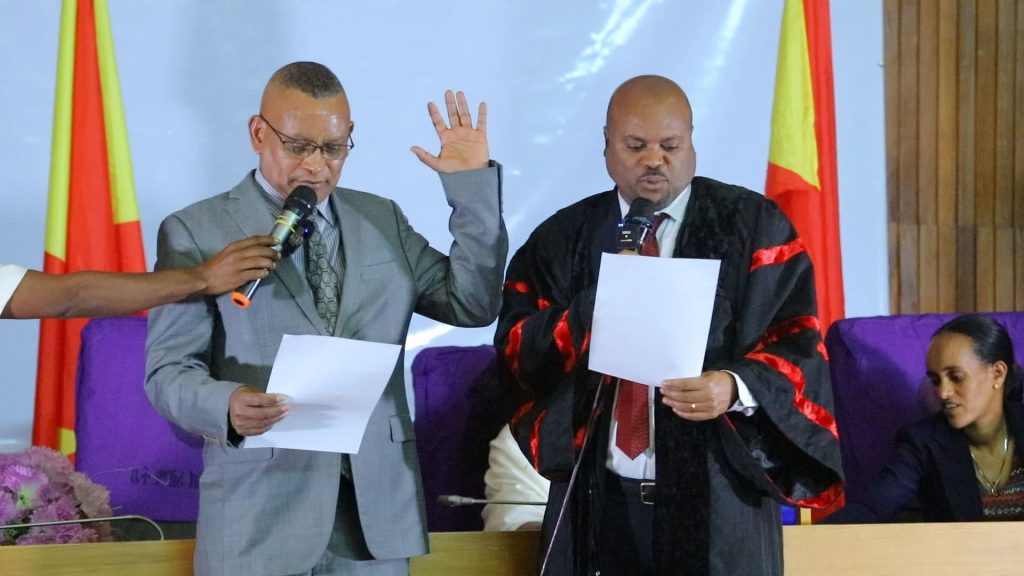
The Tigray Regional Council has officially appointed Debretsion Gebremichael (PhD) as the President of the Tigray region, a move that significantly intensifies the ongoing power struggle within the Tigray People’s Liberation Front (TPLF).
This decision, made during a session in Mekele, challenges the existing administrative status quo and marks a formal break from the unified governance structure envisioned following the two-year conflict in northern Ethiopia.
The Council resumed its regular sessions after a three-year hiatus, citing the need to protect the region’s autonomy. In its official statement, the Council alleged that the Federal Government has violated several terms of the Pretoria Peace Agreement, justifying the return to a pre-war constitutional framework. This move effectively creates a “dual-administration” scenario, as the federally recognized Interim Regional Administration (IRA) continues to operate as the legal executive body under the peace accord.
Supporters of the appointment argue that the move is a vital step toward restoring constitutional order and ensuring that the Tigrayan people are governed by their elected representatives. They maintain that the regional council remains the legitimate legislative authority according to the 1995 FDRE Constitution. By reinstating Debretsion Gebremichael, the faction led by the TPLF chairmanship seeks to consolidate political power within the party’s institutional structures.
Conversely, the Interim Regional Administration and various security leaders have expressed deep concern over the legality of the Council’s actions. Lieutenant General Tadesse Worede and other IRA officials have warned that such unilateral moves risk undermining the fragile peace process established in November 2022. They contend that the IRA is the only legal entity recognized by the Federal Government to transition the region toward permanent stability and future elections.
The Federal Government has historically maintained that any regional council meetings or appointments outside the framework of the Pretoria Agreement are “null and void.” While an official response to this specific appointment is pending, the move places federal authorities in a difficult position regarding budget allocations and legal recognition. This political friction threatens to stall the Disarmament, Demobilization, and Reintegration (DDR) programs essential for long-term security.
As the political rift between the TPLF leadership and the IRA deepens, analysts fear that the administrative deadlock could hinder humanitarian efforts and the return of internally displaced persons. The presence of two competing leadership structures in Mekele creates significant uncertainty for international partners and local residents alike. The coming weeks will likely determine whether a mediated dialogue can resolve this internal crisis or if the region faces a prolonged period of political instability.