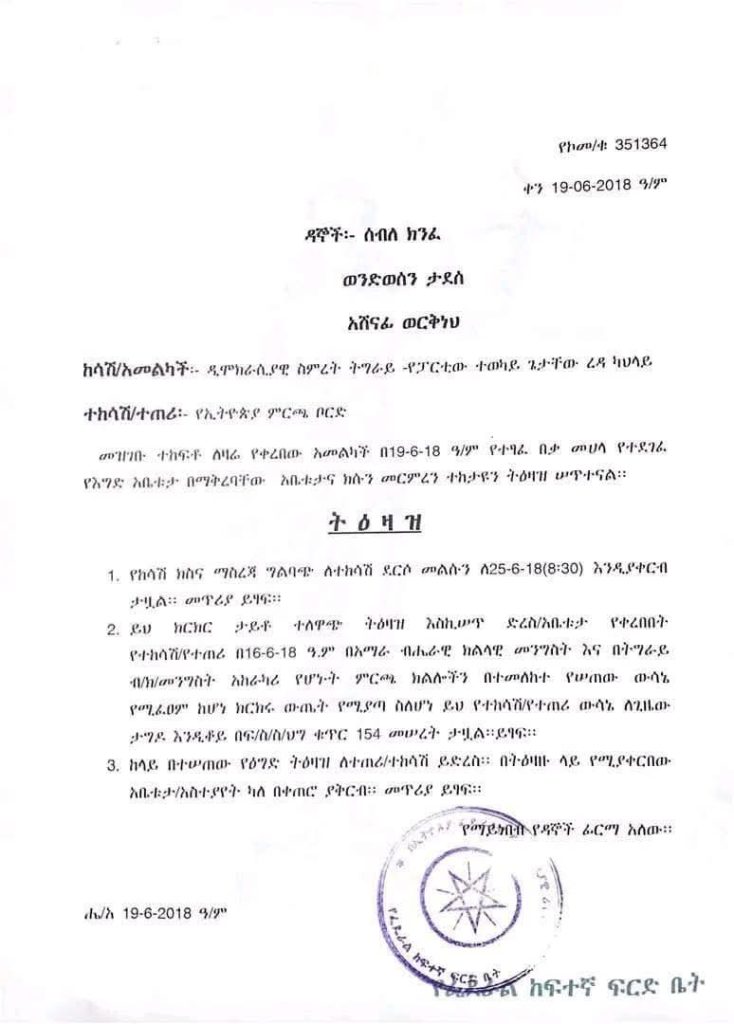
A federal court has issued an injunction suspending the decision to conduct parliamentary elections in the sensitive and disputed Ethiopian districts of Raya and Wolkait.
The ruling comes just days after the House of Federation (HoF)—the upper chamber of the Ethiopian parliament—passed a controversial resolution to hold elections for the House of People’s Representatives in five constituencies within these areas.
The HoF had initially determined that these elections should proceed as part of the upcoming national polls, a move that was quickly followed by an announcement from the National Election Board of Ethiopia (NEBE) stating its readiness to implement the directive.
The districts of Wolkait, Humera, Telemt, Afla, and Alamata have been at the heart of a long-standing and often violent territorial dispute between the Amhara and Tigray regional states. Since the cessation of the northern conflict in late 2022, the administrative status of these lands has remained one of the most volatile issues in Ethiopia’s recovery process.
The court’s intervention follows a legal challenge that questioned the constitutionality of holding elections before the final status of these territories is resolved. Critics and legal experts argued that conducting a vote under the current “status quo”—where the areas are largely under the administration of neighboring forces or interim authorities—could bypass the formal boundary dispute resolution mechanisms outlined in the Pretoria Peace Agreement.
The injunction effectively freezes;voter registration activities in the five disputed constituencies and the deployment of election materials to these specific districts.
Any administrative steps by the NEBE to finalize candidate lists for these seats.
Reactions from Regional Stakeholders
The Tigray Interim Administration (TIA) had previously voiced strong opposition to the House of Federation’s decision.
In a statement issued earlier this week, the TIA labeled the move a “dangerous path” that contravened the federal constitution and risked de-stabilizing the fragile peace in the north. They argued that regional and federal elections cannot be held until the displaced populations from these areas have fully returned and the “illegal” administrative structures currently in place are dismantled.
On the other hand, representatives from the Amhara region and local committees in the disputed zones have historically pushed for the inclusion of these districts in the national political process, citing the need for formal representation in the federal parliament.
The National Election Board, led by Chairperson Melatwork Hailu, now faces the daunting task of re-adjusting its electoral roadmap. While the NEBE has recently modernized its systems—including the launch of a new digital platform for candidate registration—this legal roadblock complicates the logistics of a nationwide vote.
Legal analysts suggest that the case will now likely move to a higher court or require a joint constitutional interpretation. “The court is prioritizing the ‘preventative’ aspect of law,” noted one legal scholar in Addis Ababa. “By halting the process now, they are avoiding a scenario where a contested election result further inflames ethnic tensions.”
As Ethiopia approaches its 7th General Election, scheduled for June 1, 2026, the fate of the Raya and Wolkait voters remains in limbo. The government has yet to issue a formal response to the court’s injunction, but the ruling marks a rare instance of judicial intervention in a high-stakes decision made by the House of Federation.