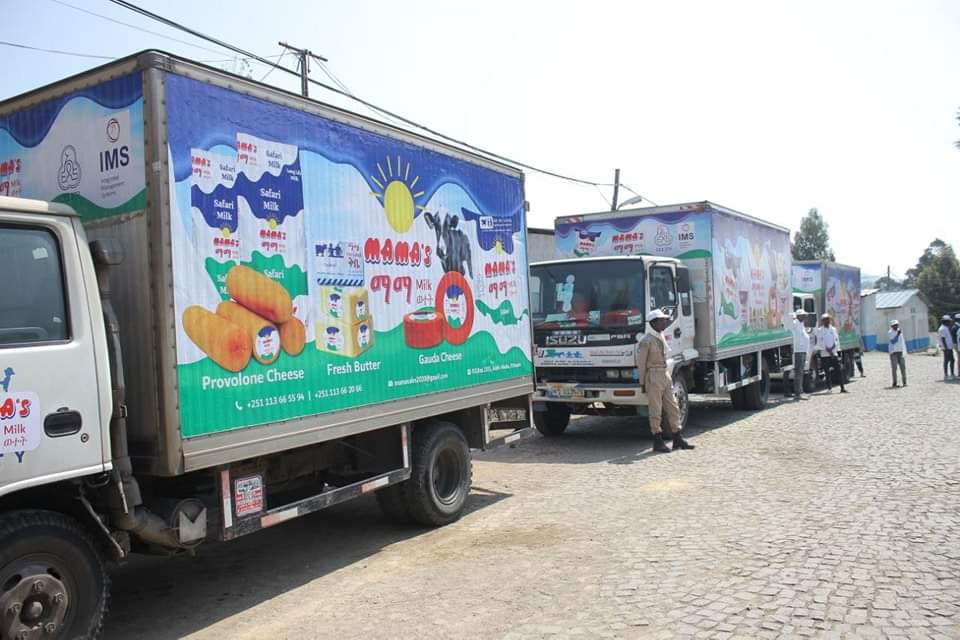
Sebeta Agro Industry, also referred to as Mama Milk, has been a supplier of milk and dairy products to Ethiopia for thirty years. Yesterday, the company announced that it is changing the packaging and logo colours of its products because there are many products with nearly identical packaging and logos on the Ethiopian market, making it difficult for customers to identify the correct Mama product.
During the news briefing, the firm noted that the volume of milk products being offered under virtually identical Mama’s milk packaging provides a hurdle even as the farm business works to boost capacity. Additionally, it informs customers that as of January 13, 2024, the pasteurised milk container has been modified with Ethiopia’s mandatory standards logo, which is coloured blue, white, and green.

The blue colour utilised in the packaging is a representation of the organization’s logo. The type of grass the cows eat is indicated by the green hue of the packages.In addition, the white colour of the containers draws attention to the milk that the company produces.
In the middle of the packages is the bold word “Mama” printed in both Amharic and English. It is written in red.
According to Ato Mulugeta Yemer, CEO of Sebeta Agro Industry, a buyer purchasing any product runs the risk of doing so if they compare it to another product that is packaged identically. This alludes to the trademark and color-changing packaging of Mama Milk.

“Our customers are proof that we produce Mama milk in quality and present it in the market.” This clarifies why we have spent so much time in this industry. However, we had to alter the colour of our packaging and logo after learning that some of our consumers had mistakenly purchased milk products with the same packaging under the mistaken impression that it was Mama milk.
“It feels and looks that way, too, but the colours also add to a more modern aesthetic. In addition to using this branding relaunch as an opportunity to create a design and colour scheme system that would make it simpler for customers to understand the distinctions across our product lines, consumer research helped us decide what to highlight on our packaging.” He said.
The CEO further asserted that with the introduction of a new Artificial Insemination (AI) breeding technique at Sebeta Agro Industry that uses the semen of superior breeds, dairy farmers should expect increased milk yield.
“We get better milk production the better bred cow we have.” We introduce a bull of superior breed, mate with a neighbouring caw, then intentionally inseminate the caw with the semen to accomplish this. “
“In order to enable our milk suppliers around the nation to produce up to 40 litres of milk per cow, we will first use the breed cow for our milk production. After that, we will distribute the breed cow or bull to them. For individuals who require their cows to produce more milk, we likewise intend to carry out the same action.”He added.
Sebeta Agro Industry was established with a capital of 200 million birr, but today it has more than 500 million birr.
It currently holds a market share of more than 50%.
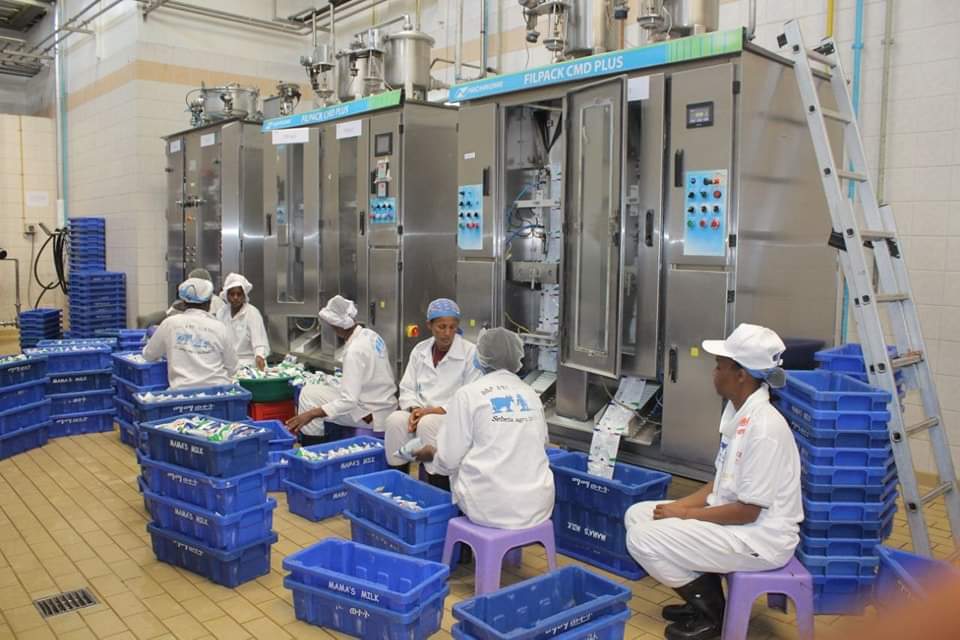
Mama Milk produces pasteurised milk and milk products, which are then sold across the country, using a cutting-edge laboratory, production tools, and knowledgeable employees.
The company stated that it follows Ethiopia’s mandated quality rules by producing its milk and dairy products in a cutting-edge laboratory under stringent quality supervision.
Thanks to the work of more than 400 permanent employees, it provides income for more than 50,000 herders who supply raw milk, more than 150,000 herdsmen’s families, and more than 600 traders who sell and distribute items in line with its product chain.
Thanks in part to Mama, which is well-known for having proven its profitability during the preceding 28 years, paying taxes to the government on time, and earning awards, 200,000 people now have direct and indirect work opportunities.
In order to fulfil its duty to society Mama is making his point by giving the residents of the plant surroundings access to utilities like power and clean drinking water.
In order to provide animal feed to raw milk producers, it is now constructing a balanced fodder processing business. Additionally, it aims to supply pastoralists with approximately 2,000 superior dairy cows annually.