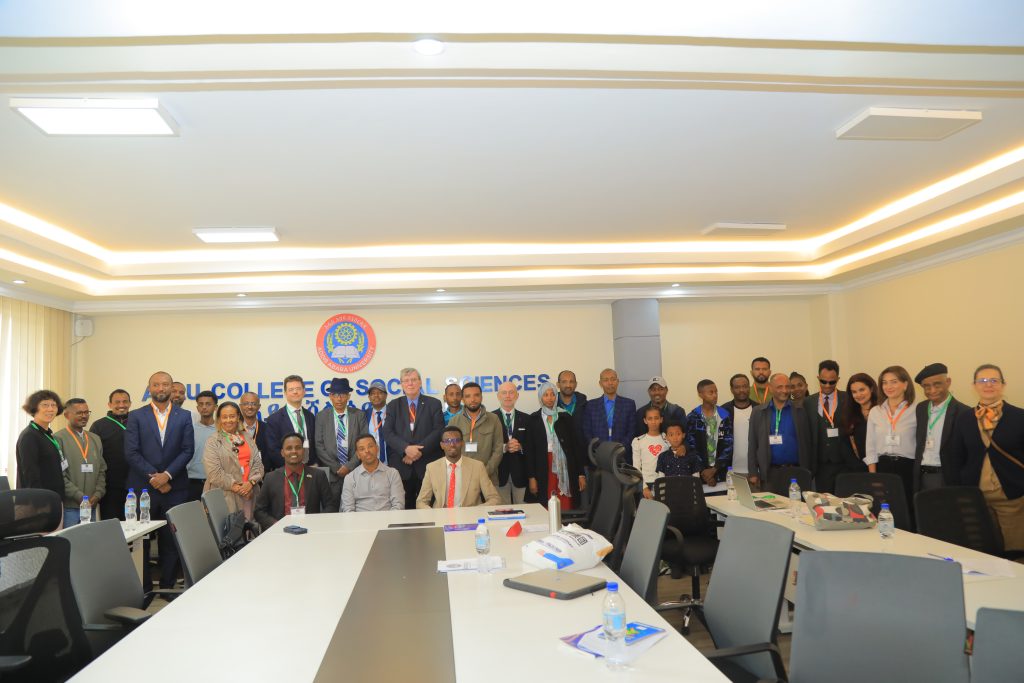
Leading international academics, researchers, and global delegates gathered at Addis Ababa University (AAU) on July 20, 2026, for the opening of the International Conference on Peace and Sustainable Development: A Philosophical Exploration.
Held at Professor Bahru Zewde Hall within the College of Social Sciences, Arts and Humanities, the two-day summit brings together global experts to examine how philosophical inquiry can offer practical solutions to pressing contemporary challenges. Organized by AAU’s Department of Philosophy in collaboration with the McLean Center for the Study of Culture and Values at The Catholic University of America and The Council for Research in Values and Philosophy (RVP), the event serves as a platform for interdisciplinary dialogue spanning conflict resolution, digital governance, environmental ethics, and global justice.
The conference opened with remarks from Dr. Ezana Amdework, Executive Dean of the College of Social Sciences, Arts and Humanities at AAU, who officially declared the proceedings open. Addressing attendees, Dr. Amdework emphasized that peace extends beyond the absence of conflict to encompass structural justice, inclusion, and ethical governance. He noted that host city Addis Ababa—as a continental hub for diplomacy and home to the African Union—offers a fitting backdrop for evaluating global ethical frameworks alongside indigenous knowledge systems and African philosophical traditions. Dr. Amdework highlighted the university’s role in linking academic inquiry to policy, stressing that technological and scientific advancements must be paired with rigorous moral reflection to build resilient societies.
A central focus of the academic presentations was the intersection of emerging technologies and human values. Academic Esayas Bancha presented his research, “The Pragmatic Role of Philosophy in the AI Ethics and Sustainable Development,” which argues for embedding ethical foundations directly into artificial intelligence systems.
Bancha emphasized that philosophy must serve as a operational bridge between technological innovation and responsible governance. Rather than focusing exclusively on processing efficiency, the paper advocates for an “ethics-by-design” framework to ensure AI development respects human dignity, autonomy, transparency, and environmental sustainability, thereby translating abstract theoretical concepts into actionable policy for long-term societal well-being.
The event also highlighted international cross-cultural exchanges and practical proposals from participants. Armenian journalist and master’s scholar Anna Hakobyan expressed gratitude to the organizing bodies and shared reflections on integrating Confucian and Eastern philosophical frameworks into global discussions. Hakobyan proposed establishing formal advisory councils of philosophers to assist modern political leaders, drawing parallels to historical traditions where rulers relied on institutionalized philosophical counsel to guide governance.
She further suggested organizing joint international conferences to deepen scholarly collaboration, pointing to her home country’s seventh-century heritage as a potential foundation for future institutional partnerships.
Run up to July 21, the summit featured speakers from institutions across Africa, Europe, North America, and Asia.
Over the course of the event, delegates discussed covering topics such as restorative justice, identity, democracy in the digital age, and environmental stewardship.
Organizers and university officials expressed hope that the relationships and research partnerships formed during the two-day gathering will extend beyond academia, fostering evidence-based policies and international cooperation to address systemic global crises.