The history of Ethiopia is a tapestry woven with threads of unmatched bravery and profound sorrow. Among its most somber yet defining chapters is the massacre of Yekatit 12 (February 19, 1937). It was a day when the sun rose over Addis Ababa only to be obscured by the smoke of burning homes and the cries of the innocent. What began as a staged celebration of Fascist “benevolence” transformed into a three-day inferno of systemic extermination, leaving a scar on the heart of the nation that remains a symbol of resilience to this day.
The Deceptive Invitation: A Trap at the Palace
In 1937, Fascist Italy had occupied Ethiopia for nearly a year. Rodolfo Graziani, the Viceroy of Italian East Africa—a man whose brutality in Libya had already earned him the moniker “The Butcher”—sought to project an image of absolute control. To celebrate the birth of the Prince of Naples, Graziani announced a public distribution of alms.
The setting was the Genete Leul Palace (now the site of Addis Ababa University at Sidist Kilo). The invitation was a cruel mockery: the poor, the elderly, and mothers clutching their infants gathered by the thousands, hoping for a few coins or a loaf of bread. As Graziani stood on the palace balcony, looking down with imperial disdain, he was unaware that among the crowd stood two young men who would change the course of the occupation: Abreha Deboch and Mogus Asgedom.

The Spark of Resistance: The Assassination Attempt
Abreha and Mogus were not strangers to the Italian administration; they worked within it. Abreha served as a translator in the Political Bureau, while Mogus held a similar administrative role. However, their proximity to the enemy only deepened their inner fire. They witnessed daily the humiliations of their people—the arrests, the executions, and the trampling of the Ethiopian flag.
Supported by the intelligence and courage of the legendary patriot Shewareged Gedle, the two young men swore a blood oath. They realized that working for the enemy while their country bled was a betrayal of their soul. At approximately 12:45 PM, as the ceremony reached its peak, Abreha and Mogus unleashed their defiance. They threw a series of hand grenades toward the balcony.
The explosions shattered the air. Shrapnel tore through the Italian ranks, and Graziani fell, severely wounded with over 350 pieces of metal in his body. In the chaos that followed, the two heroes managed to escape the palace grounds, but their act of bravery triggered a demon that had been lurking beneath the surface of the Fascist occupation.
Three Days in Hell: The Systematic Massacre
The retaliation was not a military response; it was a state-sponsored slaughter of civilians. As Graziani was rushed to the hospital, the order was given: no mercy for any Ethiopian.
For the next three days, Addis Ababa became a slaughterhouse. Italian Blackshirts, joined by local civilians loyal to the regime, took to the streets armed with rifles, daggers, clubs, and canisters of gasoline.
- The Fire: Soldiers went from district to district, locking the doors of traditional mud-and-thatch houses (tukuls) from the outside. They soaked the thatch in petrol and set them ablaze. Families—fathers, mothers, and children—were burned alive or suffocated by smoke. Those who tried to crawl out through windows were pushed back into the flames or bayoneted on the spot.
- The Streets: The cobblestone streets of the capital ran red. Witnesses recounted horrors that defied human comprehension: infants being snatched from their mothers and dashed against walls, or men being dragged behind military trucks until their bodies were unrecognizable.
- The Rivers: The Kebena and Entoto rivers, usually sources of life for the city, turned crimson. For weeks, the water was unusable as it carried the remains of the thousands who had been executed along its banks.
Estimates of the death toll vary, but historians generally agree that nearly 30,000 Ethiopians—roughly 20% of the city’s population at the time—were murdered in those 72 hours.
The Agony of Debre Libanos
The Fascist vengeance did not stop at the city limits. Convinced that the Ethiopian Orthodox Church had provided spiritual and logistical support to the assassins, the Italians turned their sights on the Debre Libanos Monastery.
On May 20, 1937, Italian forces surrounded the historic monastery. In one of the most heinous acts against a religious institution in modern history, they executed 447 monks and deacons, including the head of the monastery, Abune Tekle Haymanot. The goal was simple: to break the moral and spiritual backbone of the Ethiopian people. Instead, it solidified the Church’s role as a pillar of the resistance.
The Sacrifice of the Heroes
Abreha Deboch and Mogus Asgedom fled toward the Sudanese border, hoping to reach international territory to tell the world of the atrocities occurring in Ethiopia. Their journey was a harrowing odyssey through the wilderness.
Tragedy struck in the desert when Abreha contracted a severe case of malaria. Weakened and dying, he urged Mogus to leave him behind and continue the mission. “I may stay here,” he is quoted as saying, “but you must reach Sudan. Our country will be free.” Mogus buried his friend in the lonely sands of the desert and pushed on, only to be captured and executed by Italian collaborators near the border. Though they did not live to see the liberation, their names became synonymous with the “Price of Freedom.”
A Monument to Resilience: The Yekatit 12 Obelisk
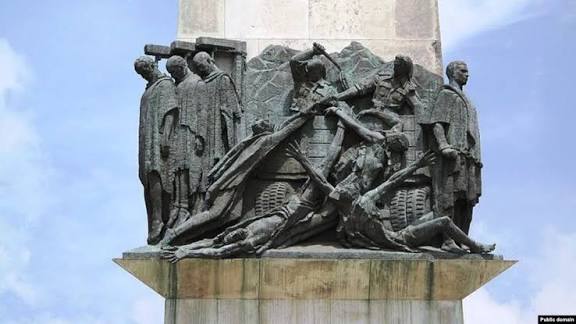
Today, if you stand in the center of the Sidist Kilo roundabout in Addis Ababa, you will see a towering white obelisk. It is 28 meters tall, representing the 28th year of the reign of Emperor Haile Selassie at the time of the invasion. But it is more than just stone and mortar.
The bronze reliefs on the monument depict the agony of those three days: the mothers grieving over lost children, the burning houses, and the stoic faces of the martyrs. It serves as a permanent witness to a generation that chose death over the indignity of colonial chains.
The Legacy of the Blood
The Massacre of Yekatit 12 was intended to terrorize the Ethiopian people into submission. Graziani believed that by “decapitating” the intelligentsia and the youth of the capital, he would extinguish the fire of rebellion. He was wrong.
The blood spilled in the streets of Addis Ababa acted as fertilizer for the Patriot (Arbegnoch) movement. From the ashes of the burned homes rose a renewed determination. The news of the massacre eventually reached the global stage, stripping away the thin veneer of “civilization” the Fascist regime claimed to be bringing to Africa.
“Ethiopia shall stretch out her hands unto God.”
This biblical promise was the anthem of the survivors. The martyrs of Yekatit 12 did not die in vain; they became the foundation upon which the 1941 victory was built. Their sacrifice reminds us that freedom is never a gift—it is a hard-won inheritance paid for in blood.
As we remember this dark anniversary, we honor not just the 30,000 who fell, but the spirit of a nation that refuses to break. The sky over Addis Ababa may have turned black on that fateful February day, but it eventually cleared to reveal a sun that shines on a sovereign and proud Ethiopia.