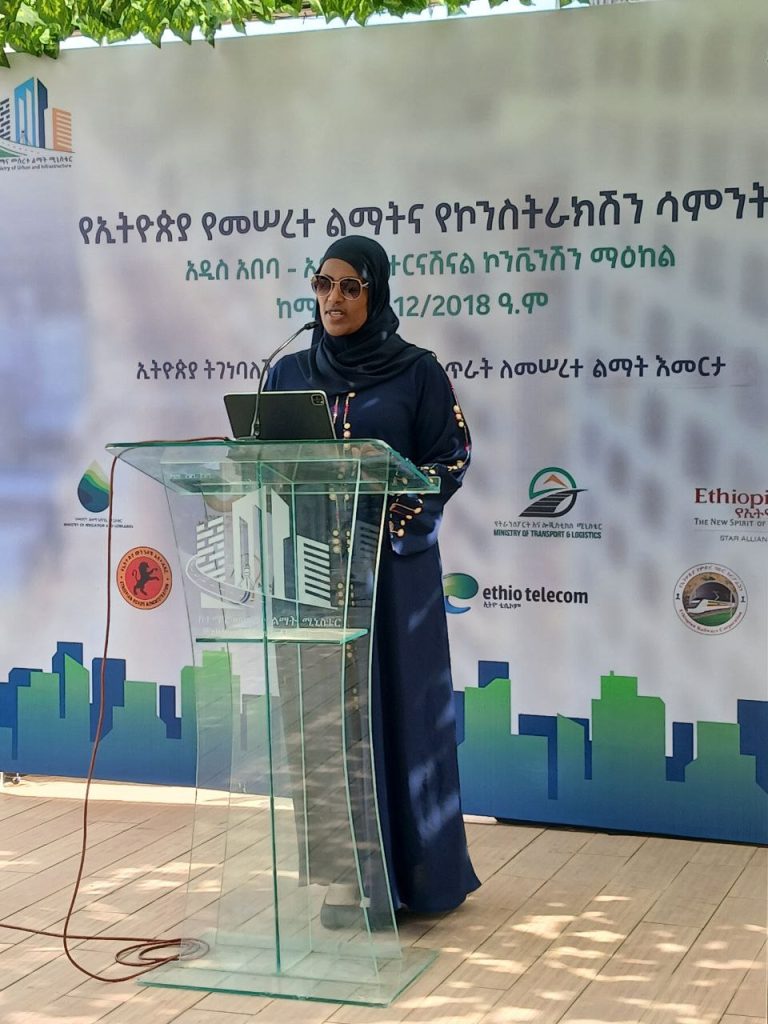
The Ethiopian Ministry of Urban and Infrastructure has announced today that the “Ethiopia Infrastructure and Construction Week” will be held in Addis Ababa from April 17 to 20, 2026.
This event is scheduled to take place at the Addis International Convention Center, serving as a primary stage for the nation’s builders.
Under the theme, “Ethiopia is Building! Innovation, Speed, and Quality for Infrastructure Leap,” the week aims to synchronize the efforts of various stakeholders toward a unified national vision.
Minister of Urban and Infrastructure, Chaltu Sani, highlighted that the primary objective of this week is to showcase the massive achievements recorded in the sector over recent years.
By documenting and sharing best practices, the ministry hopes to create a blueprint for future projects that can be scaled across different regions of the country. This gathering is not just a celebration of past success but a strategic move to ensure that future developments are grounded in proven methodologies.
A central goal of the forum is to significantly bolster domestic production capacity within the construction industry. The ministry intends to use this platform to accelerate the transfer of modern technologies from international partners to local firms. By strengthening the integrated working relationship among government bodies, private contractors, and academic researchers, the event seeks to create a more cohesive and resilient industrial ecosystem.

The scheduled program features an extensive exhibition where cutting-edge construction methodologies and digital tools will be introduced. This includes a focus on modernizing traditional building practices to meet international standards of efficiency. Participants will have the chance to interact with the latest hardware and software solutions that are currently transforming the global construction landscape, providing a hands-on look at the future of the industry.
In a move to foster excellence, the event will include a dedicated ceremony to recognize and award contractors, consultants, and professionals. These awards will be granted to those who have demonstrated exceptional performance, strict adherence to safety protocols, and a commitment to high-quality outputs. By honoring these industry leaders, the government hopes to incentivize a culture of healthy competition and professional integrity across all levels of the sector.
Reflecting on the rapid growth of the nation’s physical connectivity, Minister Chaltu noted that Ethiopia has successfully expanded its road network from 144,000 kilometers to 182,000 kilometers in just the last five years. This significant leap highlights the government’s commitment to linking rural areas with urban markets. The “Construction Week” will provide a transparent venue for the public to see how these massive investments are being managed and the impact they have on daily life.
Furthermore, the exhibition is expected to draw a diverse array of international companies and development partners. Their participation is seen as a vital catalyst for attracting foreign direct investment and fostering global business partnerships.
The ministry believes that by positioning Ethiopia as a burgeoning hub for infrastructure in East Africa, the country can secure the technical and financial support needed for even larger future projects.
Ultimately, the event is anticipated to have a profound impact on job creation and economic transformation. By bridging the gap between tech-driven startups and established construction giants, the forum facilitates networking that can lead to thousands of new employment opportunities for the youth.
As Ethiopia continues its journey toward becoming a middle-income economy, this construction week stands as a testament to the nation’s enduring focus on building a sustainable and modern future.
The construction sector remains a powerhouse for the national economy, contributing nearly 20% to Ethiopia’s annual GDP. This makes it one of the most critical sectors for maintaining overall economic stability and driving industrial growth.
Because of this massive weight, the upcoming event is viewed as a key indicator of the country’s fiscal health and its ability to sustain long-term capital investments.
For the 2026 event, there is a renewed and urgent focus on “Green Construction” and sustainable development.
The ministry is actively promoting the use of eco-friendly materials that significantly reduce the carbon footprint of large-scale urban projects. This shift aligns with global climate goals and ensures that Ethiopia’s rapid urbanization does not come at the cost of environmental degradation, setting a standard for future regional developments.
A significant portion of the exhibition will center on the recent success of the Addis Ababa Corridor Development. This initiative has been praised for modernizing the capital’s aesthetics, enhancing pedestrian accessibility, and improving traffic flow in record time. By showcasing these results, the government aims to demonstrate how rapid urban renewal can be executed effectively through strong leadership and coordinated planning.
The ministry is heavily pushing for the widespread adoption of Smart City technologies and digital integration. By incorporating advanced digital management systems into new infrastructure projects, the government intends to improve the long-term maintenance and longevity of public assets.
This move toward high-tech infrastructure is expected to position Ethiopia as a leader in the digital transformation of African cities.
Despite the ambitious road expansion projects mentioned by the Ministry, critics point to the persistent issue of project delays and cost overruns.
Many large-scale infrastructure projects in Ethiopia have historically exceeded their initial budgets by significant margins due to poor planning and fluctuating material costs.
Analysts argue that unless the “Construction Week” addresses the root causes of these inefficiencies—such as bureaucratic red tape and inadequate feasibility studies—the event may serve more as a public relations exercise than a catalyst for genuine reform.
There is also a growing concern regarding the heavy reliance on foreign contractors and debt-financed infrastructure. While the Ministry highlights the transfer of technology, some local industry players feel that domestic firms are often sidelined in favor of giant international corporations for high-value contracts.
Critics suggest that the government needs to move beyond “showcasing” and instead implement aggressive policies that mandate local participation and ensure that the wealth generated by these projects remains within the Ethiopian economy.
Furthermore, the focus on “Green Construction” and “Smart Cities” has been met with skepticism by those who point to the maintenance crisis of existing infrastructure.
Critics argue that while the country is quick to build new roads and corridors, the budget for maintaining current assets is often neglected, leading to rapid deterioration.
They suggest that the forum should prioritize “Asset Management” over “New Construction” to ensure that the billions of Birr already invested do not go to waste within a decade.
The displacement of residents during rapid urban corridor developments remains a sensitive and highly criticized topic. While the aesthetic and functional improvements in Addis Ababa are undeniable, social critics highlight the human cost of these “speedy” projects. There are calls for the Ministry to use this upcoming platform to establish more transparent and equitable compensation frameworks, ensuring that infrastructure development does not come at the expense of the city’s most vulnerable populations.