By Sahar Zaman
My recent trip to the World Public Summit in Moscow shook me out of my comfort zone where I believed I knew a lot about the world of visual arts. I had just finished delivering a series of speeches on the global stage about the Orange Economy. Walking out of the conference halls and into the grand corridors of the World Trade Centre, a massive art display caught my eye. Spreading across the entire venue was a special, exclusive exhibition focusing entirely on contemporary African art. I was surrounded by canvases in deep reds, browns and yellows with artists from Ghana, Congo, Zambia, Kenya, Tanzania and many other nations of the rising continent.
I take great pride in my deep connection to Indian art, yet I am struck by a sudden realization: when it comes to contemporary African art, I draw a blank. Since 2002, I have been on the front lines of India’s modern and contemporary art movement. My writing helped shape the narrative of Indian art becoming a serious blue-chip asset, celebrating powerhouse names like Husain, Raza, Souza, Gaitonde, Subodh Gupta, Atul Dodiya, Rekha Rodwittiya. I immersed myself in every corner of the industry—writing reviews, analysing market ratings, tracking auctions, and even exposing a counterfeit art ring to bring the art world into mainstream 9 PM news. Christie’s, Sotheby’s, and Bonhams weren’t just auction houses to me; their listings were at the very tip of my fingers. Today, the total value of the Indian art market stands close to $720 million.
Beyond India, my lens extended to the broader Asian art scene, where I tracked the meteoric rise of Chinese contemporary art as it broke out of regional confines to dominate the global market. In 2023, China overtook the United Kingdom to become the world’s second-largest art market by value, behind only the United States. By 2025, China’s art market as a whole was worth roughly $8.5 billion a year. Simultaneously, I kept a pulse on the international Western market; auctions featuring masterworks from Van Gogh and Picasso to contemporary giants like Damien Hirst and Tracey Emin were entirely familiar territory to me.
The art historical narrative, traditionally skewed towards Western perspectives, has long undervalued African art, limiting its global visibility and appreciation. This trend, however, has changed as collectors from around the world are increasingly begin to appreciate African art’s rich history and significance.
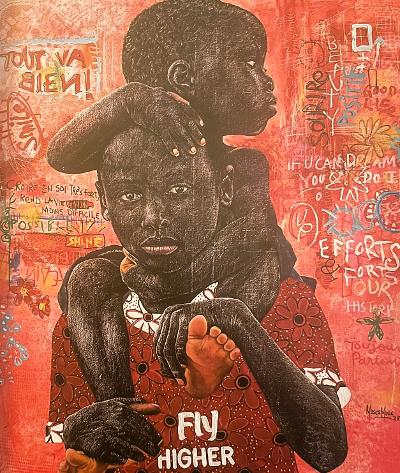
Unfortunately, contemporary art from Africa is viewed from the lens of homogeneity, refusing to acknowledge the spectrum of exceptional diversity. At the exhibition titled “New World: Africa in Shaping a Shared Future”, artists reinterpret traditional forms, religious imagery, historical memory and everyday experiences.
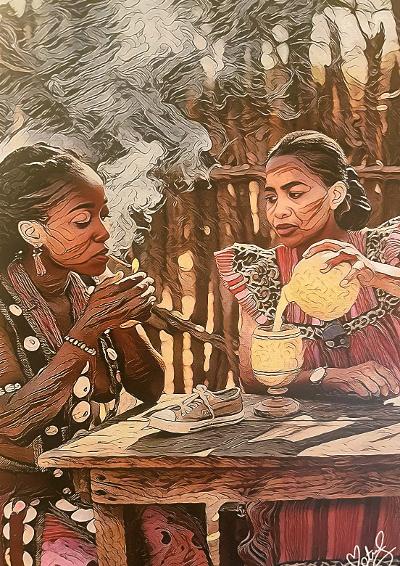
Moses Mous from Cameroon explores collective trauma of conflict through the style of sgraffito in which the upper layer of paint is scratched off to reveal an underlying painted form. Vetutekule Shikongo from Namibia is a multimedia illustrator who uses her images to preserve memory as well as sustain cultural continuity by featuring female strength in context to African heritage. Khalifa Mane from Senegal addresses social injustice, poor governance and the country’s wealth gap in his multilayered collages.
And LesegoSeoketsa from South Africa brings in large swathes of an intense palette to explore the theme of women’s identity after apartheid which looks positively in the direction of liberation and self-determination.
The rise of contemporary African art as a global market has only been a recent phenomenon since early 2020s. While the contemporary African art market’s dollar value remains small compared to other regions, it has experienced remarkable growth. The global art market is estimated to be worth around $68 billion. London-based research firm ArtTactic says work by African artists already peaked at $116.5 million in 2021 and is expected to rise further.
Sahar Zaman is an award-winning author, journalist, political newsanchor and cultural curator. She is an advocate for the Orange Economy through her platform, Hunar TV – Making Art Accessible. Her best-selling book on Indian cinema is titled, ‘Talat Mahmood The Definitive Biography’.