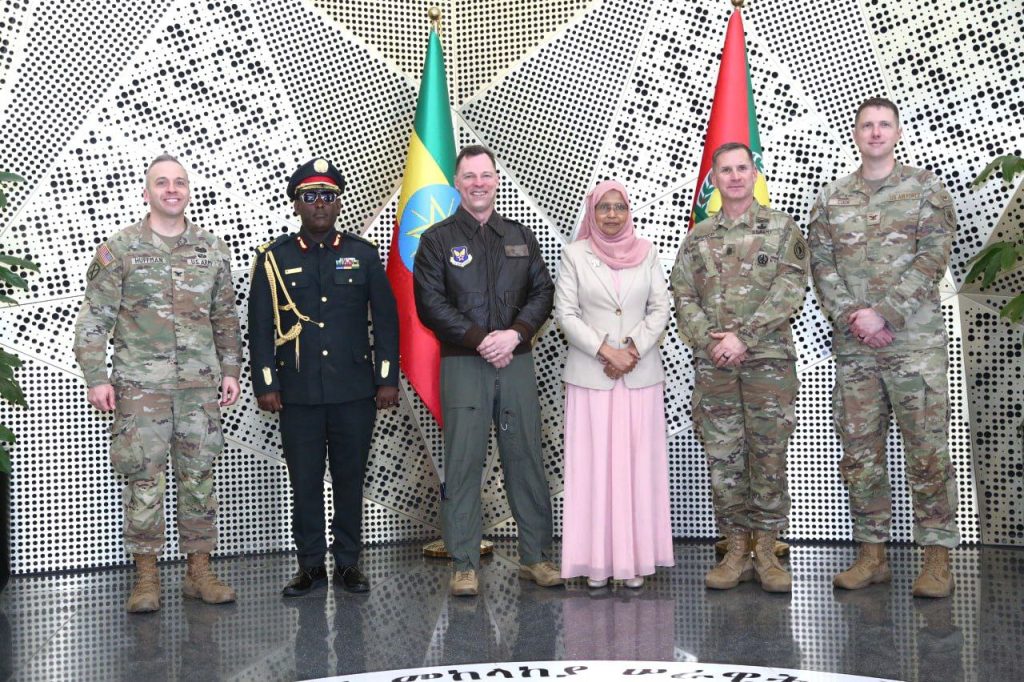
In a move that signals a cooling of past diplomatic tensions and a pivot toward long-term regional stability, Ethiopia and the United States have formally agreed to modernize their strategic military partnership. The high-stakes agreement was finalized following a series of consultations between Ethiopia’s Minister of Defense, Engineer Aisha Mohammed, and the Commander of the U.S. Africa Command (AFRICOM), General Dagvin R.M. Anderson.
This revitalization of ties comes at a critical juncture for East Africa. As the region grapples with shifting maritime interests, internal transitions, and the persistent threat of cross-border insurgency, the alignment of the two powers represents a “strategic anchor” for the Horn of Africa.
A Century of Diplomacy and Defense
The relationship between Ethiopia and the United States is not merely a modern convenience; it is a historic bond spanning over 120 years. Since 1903, Ethiopia has held the distinction of being the first sub-Saharan nation to establish formal diplomatic ties with Washington.
The current renewal heavily references this legacy. A centerpiece of the recent discussions was the 90th Anniversary of the Ethiopian Air Force. In the 1920s and 30s, American aviation expertise played a foundational role in building Ethiopia’s aerial capabilities. By framing the new agreement around this anniversary, both nations are signaling a return to a “mentor-partner” relationship, where U.S. technical prowess meets Ethiopia’s seasoned ground-level experience.
The Security Calculus: Counter-Terrorism and Maritime Safety
At the heart of the new agreement is a shared concern over the expansion of Al-Shabaab and ISIS-linked militants in the region. For two decades, Ethiopia has acted as a primary barrier against the spread of extremism into the wider continent. As the largest contributor of personnel to regional peacekeeping missions, the Ethiopian National Defense Force (ENDF) remains the most vital boots-on-the-ground partner for U.S. interests in Africa.
The renewed partnership focuses on several modern security pillars:
- Intelligence and Surveillance: The U.S. has committed to increasing the flow of real-time intelligence data and providing training for advanced surveillance technology. This is intended to help Ethiopia secure its vast borders and monitor insurgent movements with greater precision.
- Red Sea and Bab al-Mandeb Security: With global trade routes through the Red Sea under constant threat from piracy and regional instability, the U.S. is increasingly viewing Ethiopia as a key continental power that can influence maritime safety. The agreement outlines joint cooperation to prevent the Horn from becoming a launchpad for maritime disruption.
- Professionalization and Training: Beyond equipment, the partnership emphasizes “institutional capacity building.” This includes high-level officer exchanges and training programs designed to align Ethiopia’s defense architecture with international standards of modern warfare and human rights.
Strategic Analysis: Why Now?
The geopolitical landscape of 2026 is vastly different from that of the previous decade. Washington is currently navigating a “Great Power Competition” in Africa, where other global players are vying for influence through infrastructure and military sales. By renewing this strategic partnership, the U.S. is doubling down on its most reliable historical partner in the region.

From Ethiopia’s perspective, the agreement provides a much-needed boost to its defense modernization efforts. As Engineer Aisha Mohammed noted during the talks, the goal is to protect “mutual national interests.” For Ethiopia, this means maintaining its status as the regional hegemon; for the U.S., it means ensuring regional conflicts do not escalate into global crises.
The Road Ahead
This agreement transforms the U.S.-Ethiopia relationship from one of “crisis management” to one of “strategic prevention.” By investing in the technological and professional growth of the Ethiopian military, Washington is betting on Addis Ababa to remain the stabilizing force of the Horn.
The successful implementation of this pact will likely lead to more joint military exercises and a significant increase in the exchange of technical defense personnel between the two nations over the coming years.